


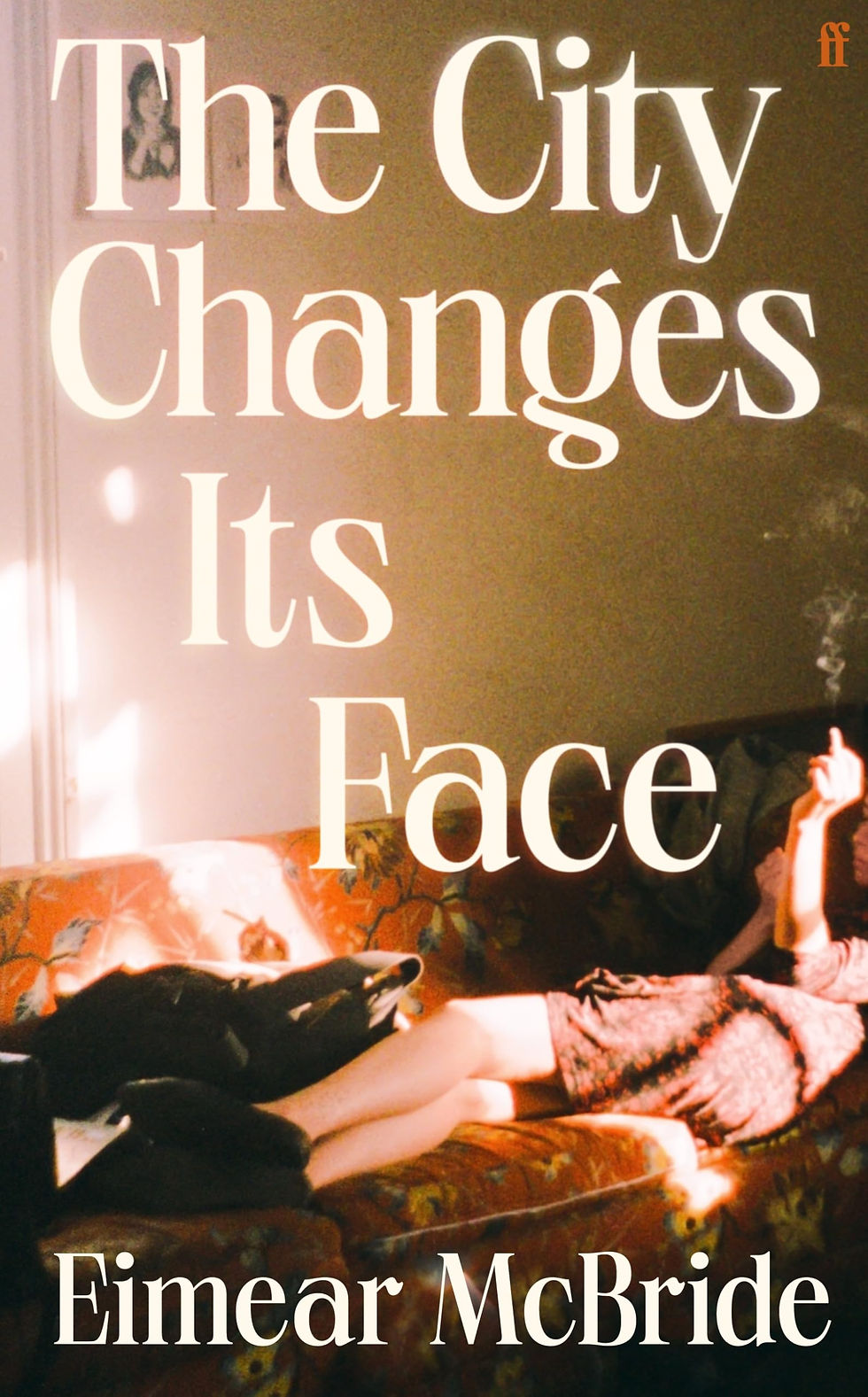
The City Changes Its Face
Reviewed by Jacquie Knott
Eimear McBride (Faber and Faber: 2025)
In anticipation of Eimear McBride’s visit to us I gave myself the great pleasure of rereading three of her four novels. A Girl is A Half Formed Thing (Galley Beggar Press: 2013) was her debut novel. Famously, it took nine years to find a publisher, but then gathered many of the major book prizes including the Desmond Elliot Prize, The Bailey’s Women’s Prize and the Goldsmiths Prize. Her second novel The Lesser Bohemians (Faber and Faber: 2016) won the James Tait Black Memorial Prize, and the other was her latest, The City Changes its Face (Faber and Faber: 2025). The last two of these are set in Camden and Kentish Town in the 1990s and have a small cast of characters shared by both, but they stand alone as novels.
Both novels centre around drama student Eily and her older partner, Stephen. Soon after The City Changes Its Face starts we know something dreadful has happened, but we have to let the novel unfold to find out what. The action takes place over one evening, but the ‘Now’ is interspersed with episodes that are headed ‘First Summer’ and ‘First Winter’, and these inform the intense conversation the two are having. McBride doesn’t shy away from the most difficult things in life and it is not always an easy read for that reason.
There is an intense sense of reality. Like Joyce’s Dublin you soon know McBride’s Camden, the routes her characters take when they venture out to the park or to The World’s End for a pint and the place where ‘the foxes eat KFC’. She deals so well with dialogue that I had the feeling that I was eavesdropping on the lives of these people. I had to remind myself I was reading a novel. I enjoyed listening to the voices she created and the cadences she gave to their voices. She does wonderful things with language, using verbs as nouns and nouns as adjectives, making new words out of old so that they are instantly recognisable. On a hot day ‘the boil outside makes sloth of us in here’. When they are leaving the old flat ‘I aspicate our past with Here’s the spot’. She also plants small quotes in the thoughts and speech of her characters. It seems to me that this inventiveness is much more like how we actually think and speak than most things I read. My own mind is a complete jumble of little things that I remember from books and songs, and they pop into my thoughts unbidden all the time.
Comments